Learning in an AI-Driven World is a Paradox
AI has fundamentally changed the feedback loop between learning and building. I build faster than ever, yet some days I feel like I know less than ever. Here is what that paradox actually means for developers.
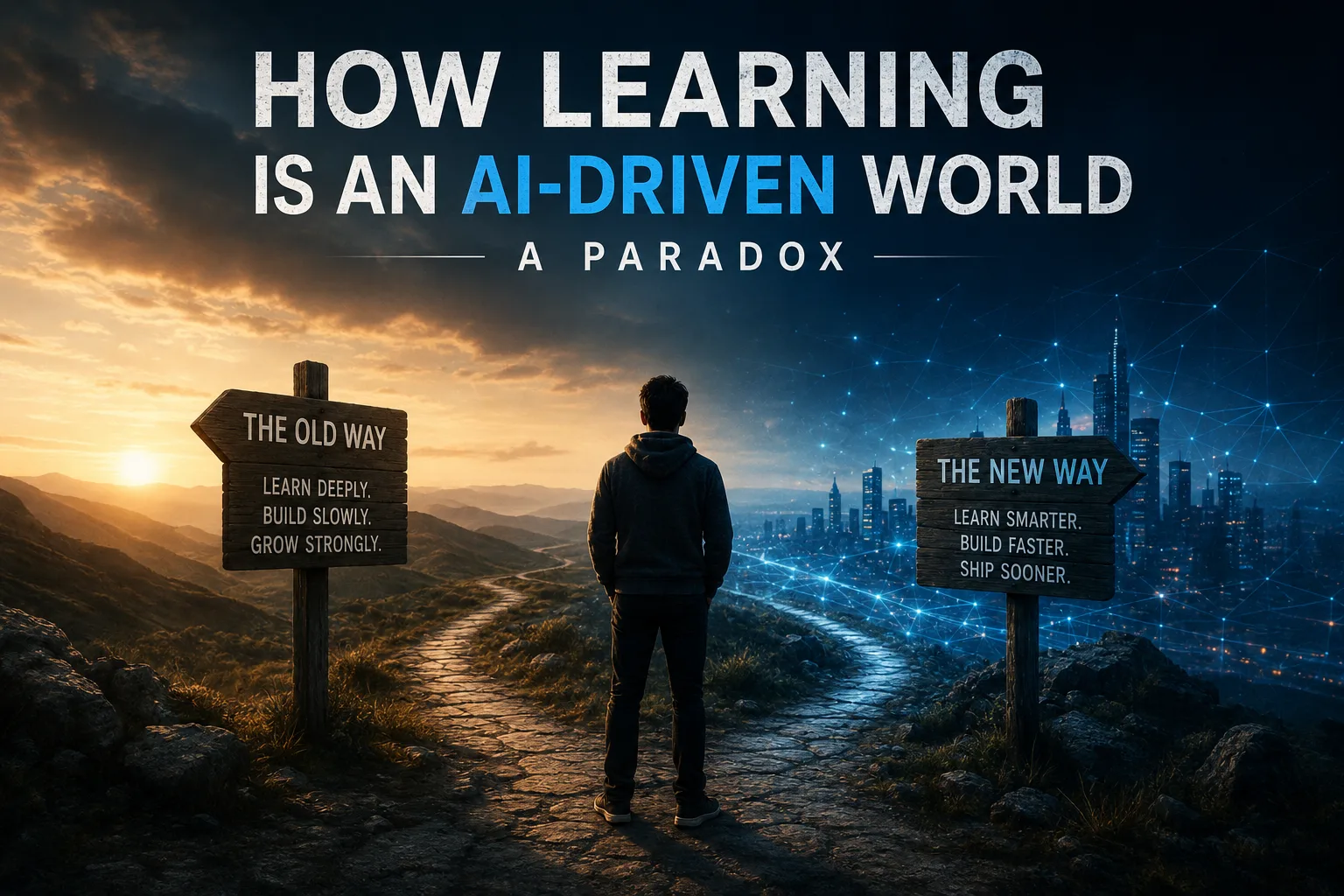
A few days ago, I was thinking about how differently I learn today compared to five years ago.
Not because I became smarter.
Not because I became more disciplined.
But because AI fundamentally changed the feedback loop between learning and building.
And honestly, I am still not sure whether that’s a good thing.
For most of my career, the learning process looked something like this:
- Learn a concept.
- Try building something.
- Realize you misunderstood half of it.
- Read documentation again.
- Refactor the code.
- Break production.
- Fix production.
- Gain wisdom through suffering.
The process was slow.
Painfully slow.
If you wanted to learn distributed systems, you spent weeks reading about CAP theorem, replication strategies, consensus algorithms, leader election, eventual consistency, and countless blog posts written by engineers who sounded smarter than everyone else.
Only after that would you attempt to build something.
And then reality would humble you.
The learning was deep because the cost of ignorance was immediate.
You couldn’t hide behind abstractions.
If you didn’t understand something, your code would eventually expose you.
The reward was equally obvious.
When you finally solved the problem, you knew you had earned it.
Your dopamine came from mastery.
Today my workflow looks very different.
I rarely sit down and spend three weeks learning a technology before touching it.
Instead:
- Learn the concept.
- Design the architecture.
- Identify the moving parts.
- Use AI to accelerate implementation.
- Analyze the output.
- Find gaps.
- Improve the design.
- Repeat until it works.
The strange thing is that I’m still making all the important decisions.
I still decide:
- System boundaries
- Database design
- Service architecture
- Domain models
- Class responsibilities
- Security concerns
- Scaling strategy
But I increasingly ask AI to write the implementation details.
Instead of writing:
function calculateInvoiceTotals(...)I describe:
Create a function that takes invoice items, applies tax rules, validates discounts, and returns normalized totals.
And AI writes it.
Then I review it.
Then I modify it.
Then I test it.
Then I ship it.
The result?
I build significantly faster than I used to.
Not 10% faster.
Not 20% faster.
Often 3–5x faster.
Sometimes more.
This is where the paradox begins.
Because while I am building more than ever, I’m not learning in the way I used to.
Five years ago, building a support ticket automation system would have forced me to manually:
- Design retrieval systems
- Learn embeddings
- Implement vector search
- Build approval workflows
- Handle prompt engineering
Today?
I can learn the concepts, understand the architecture, and have a working implementation much sooner.
The project still teaches me things.
But it teaches differently.
Instead of learning every implementation detail, I’m learning:
- System composition
- Trade-offs
- Integration patterns
- Failure modes
- Product thinking
The depth moves up a layer.
And that feels weird.
Every AI-assisted developer eventually has a day where they think:
What if I actually don’t know anything?
You look at a repository.
Half the code was generated.
The tests were generated.
The documentation was generated.
The migration scripts were generated.
And suddenly your brain asks:
Am I an engineer or just a monkey holding increasingly powerful tools?
It’s an uncomfortable question.
Because traditional software engineering trained us differently.
We were rewarded for remembering.
We were rewarded for implementation expertise.
We were rewarded for knowing obscure details.
Today?
The value of memorization is collapsing.
The value of judgment is increasing.
This isn’t the first time humanity has faced this.
Before calculators, being good at arithmetic mattered enormously.
Then calculators arrived.
Suddenly nobody cared whether you could multiply large numbers in your head.
The skill didn’t disappear.
It moved up the abstraction ladder.
Instead of learning arithmetic, people focused on algebra, statistics, and modeling.
The calculator didn’t eliminate mathematics.
It changed where human effort was best spent.
AI feels similar.
The question is no longer:
Can you write a sorting algorithm?
The question is:
Should this even be sorted here?
The implementation matters less.
The decision matters more.
This is where things get interesting.
Historically, expertise rewarded depth.
Spend ten years mastering a database.
Spend ten years mastering networking.
Spend ten years mastering operating systems.
Become the expert.
AI changes that equation.
Because now a reasonably competent engineer can:
- Build a backend
- Create a frontend
- Write infrastructure code
- Configure CI/CD
- Build AI integrations
- Generate tests
- Produce documentation
all within the same week.
Not because they mastered every domain.
Because AI acts as a force multiplier.
This makes breadth incredibly valuable.
The person who understands databases, product design, cloud architecture, user psychology, AI systems, and business workflows may outperform someone who knows one technology in extraordinary depth.
But here’s the catch.
Breadth without depth becomes dangerous.
If you don’t understand databases at all, AI can generate queries that work until they don’t.
If you don’t understand networking, AI can create infrastructure that works until production traffic arrives.
If you don’t understand security, AI can happily generate vulnerabilities at machine speed.
The future probably belongs to people with:
- Deep understanding of fundamentals
- Broad understanding of adjacent domains
- AI as an amplifier
Not people who rely entirely on AI.
And not people who reject AI.
A lot of people are starting to behave as if AI is becoming the universal skill.
Learn prompting.
Learn agents.
Learn automation.
Everything else becomes optional.
I don’t think that’s true.
AI is becoming the universal interface.
Not the universal knowledge.
Imagine asking an AI:
Design a fault-tolerant payment system.
The quality of the answer still depends on your ability to ask:
- What happens during network partitions?
- What about idempotency?
- What about reconciliation?
- What about double charging?
- What about fraud?
Those questions come from experience.
AI answers questions.
Humans decide which questions matter.
At least for now.
Five years ago we were amazed because ChatGPT could answer questions.
Today we have systems that can:
- Design architectures
- Refactor repositories
- Generate tests
- Analyze logs
- Review pull requests
- Create entire applications
Imagine what the next five years look like.
The gap between idea and implementation continues shrinking.
Eventually implementation may become nearly free.
When that happens, what becomes valuable?
Probably:
- Taste
- Judgment
- Product intuition
- Systems thinking
- Human understanding
The things that are hardest to automate.
The biggest challenge isn’t technical.
It’s psychological.
Old-school developers got satisfaction from craftsmanship.
From writing elegant code.
From spending three days optimizing something.
From understanding every line.
AI changes that reward system.
Now the reward comes from outcomes.
The system works.
The customer is happy.
The business problem is solved.
But emotionally?
That doesn’t always feel the same.
Sometimes shipping in three hours feels less satisfying than solving a difficult bug over three days.
Even if the result is objectively better.
The brain hasn’t caught up with the tooling.
I don’t think learning is disappearing.
I think learning is moving.
From implementation to orchestration.
From syntax to systems.
From coding to decision making.
From knowing answers to asking better questions.
And that’s the paradox.
I build faster than ever.
I ship more than ever.
I solve bigger problems than ever.
Yet some days I feel like I know less than ever.
Maybe that’s not a sign that AI is making us worse.
Maybe it’s a sign that the definition of expertise is changing.
And like every technological shift before it, we’re all trying to figure out where humans fit in the new stack.
I don’t know the answer yet.
But I know one thing.
The developers who spend the next decade arguing whether AI is good or bad will probably lose to the developers who learn how to think alongside it.